

Water-Filled Traffic Barriers for Data Center Construction: Why Site Teams Choose the Remcon Guardsafe 36
Quick answer: Data center construction sites use water-filled traffic barriers to separate heavy truck traffic from workers, control site circulation across multi-year phased builds, and secure perimeters — without the crane time and cost of concrete. The Remcon Guardsafe 36 is a 72" long, 36" tall, water-fillable polyethylene barrier that one worker can move empty (70 lbs) and that becomes a stable, highly visible barrier line once filled with up to 63 gallons of water.
Data center construction is one of the fastest-growing segments of U.S. commercial construction, and these projects create traffic-control demands that most job sites never see: hundreds of daily truck movements during sitework and concrete phases, multiple contractors working in parallel, active campuses where one building is operating while the next is being built, and security requirements that start on day one of grading.
This guide explains where water-filled barriers fit on a data center project, how the Remcon Guardsafe 36 compares to the alternatives, and how to plan quantities for a typical site.
Why Data Center Sites Need Dedicated Traffic Control
A hyperscale or colocation build is not a static job site. Over a 12–36 month schedule, the same access roads carry earthmoving equipment, concrete trucks, steel deliveries, generator and switchgear transports, and thousands of worker vehicle trips. Common applications for barrier lines on these sites include:
- Haul road and delivery route delineation — keeping truck routes visually separated from worker parking and pedestrian paths
- Pedestrian channelization — protected walking corridors between parking, trailers, and work areas
- Phase separation — dividing active construction from energized or operating areas on multi-building campuses
- Laydown yard and equipment area boundaries — protecting transformers, generators, and staged materials
- Temporary perimeter and gate control — quickly reconfigurable entry points as the site evolves
- Stormwater and environmental zone marking — keeping traffic off protected drains, basins, and containment areas
Because data center sites reconfigure constantly, the ability to drain, move, and refill a barrier line in hours — without a crane — is what makes water-filled barriers the default choice for everything short of positive vehicle protection.
What Is the Remcon Guardsafe 36?
The Remcon Guardsafe 36 is a water-filled traffic safety barrier made in the USA by Remcon Plastics. It is designed for work zones, construction sites, and pedestrian control applications where crews need durable, connectable, highly visible barrier lines.

| Specification | Remcon Guardsafe 36 |
|---|---|
| Length | 72 inches (6 ft) |
| Width | 24 inches |
| Height | 36 inches |
| Empty weight | 70 lbs |
| Water capacity | 63 gallons |
| Material | UV-stabilized polyethylene |
| Colors | High-visibility orange and white |
| Connectable | Yes — builds continuous barrier runs |
Empty, a single worker can position each unit. Filled, each barrier gains roughly 500 lbs of ballast, creating a stable line that stands up to wind, weather, and the daily bumps of an active site. Interlocking ends let crews build continuous runs of any length, and the 36-inch height provides strong visual separation for drivers and pedestrians. A taller version, the Guardsafe 42, is available where greater height and visibility are needed, such as higher-speed access roads.
Water-Filled Barriers vs. Concrete Barriers vs. Drums
Compared to concrete (jersey) barriers: Concrete provides crash-rated positive protection but requires flatbed delivery and crane or forklift placement for every move — a major cost on a site that reconfigures monthly. Water-filled barriers deploy and relocate with labor only. Note that standard water-filled barriers like the Guardsafe 36 are channelizing devices for delineation and pedestrian control; where crash-rated positive protection is specified (for example, adjacent to public highway traffic), follow the project's engineered traffic control plan.
Compared to drums and cones: Drums and cones mark a line but don't create a physical boundary. A connected Guardsafe run forms a continuous wall that channels pedestrians, discourages vehicle shortcuts, and defines the site edge — while remaining reusable across phases and future projects.
The practical answer for data center sites: most projects use both — concrete where the traffic plan requires positive protection, and water-filled barrier runs everywhere flexibility matters.
How Many Barriers Does a Site Need?
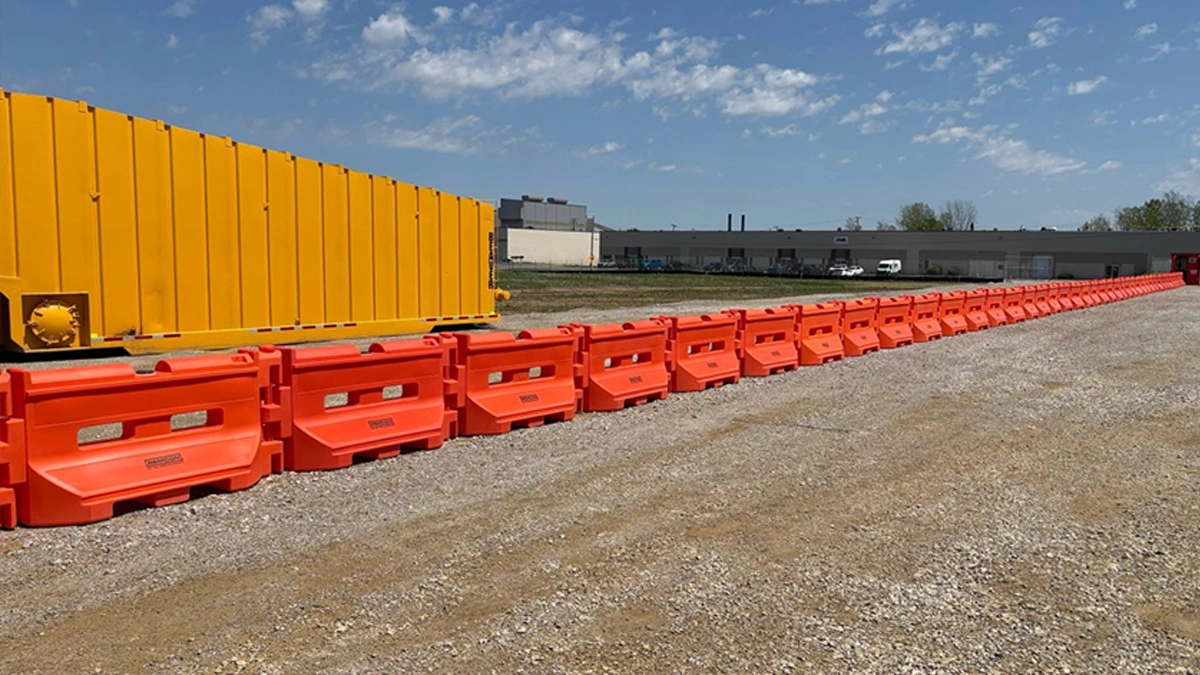
Each Guardsafe 36 covers 6 feet, so plan roughly 880 barriers per mile of continuous run, or 88 per 500 feet. Typical data center deployments we quote fall into three tiers:
- Gate and walkway packages (25–75 barriers): entry channelization, trailer-area walkways, small laydown boundaries
- Route packages (100–300 barriers): haul road delineation, parking separation, phase boundaries
- Perimeter and campus packages (300+ barriers): long-run site edges and multi-building campuses
Volume pricing applies at project quantities, and freight is quoted per shipment. For project quotes, contact Industrial and Safety Supply at orders@industrialandsafetysupply.com or (888) 926-6570.
Beyond Barriers: The Data Center Site Safety Package
Traffic barriers are usually the first order, not the last. The same sites typically need spill containment for fuel and generator areas, drain protection and stormwater management products for SWPPP compliance, cable protection for temporary power runs, and facility protection as the building comes online. Industrial and Safety Supply distributes all of these categories and can quote a combined site package.
Frequently Asked Questions
What traffic barriers are used on data center construction sites?
Data center sites typically use water-filled polyethylene barriers such as the Remcon Guardsafe 36 for traffic delineation, pedestrian channelization, and site boundaries, with crash-rated concrete barriers reserved for locations where the traffic control plan requires positive protection.
Why use water-filled barriers instead of concrete on a data center project?
Water-filled barriers can be placed, drained, moved, and refilled by hand labor as the site reconfigures across construction phases, while concrete barriers require equipment for every relocation. On multi-year phased builds, this saves significant crane time and cost.
How much does a Remcon Guardsafe 36 weigh when filled?
The Guardsafe 36 weighs 70 lbs empty. Filled with its 63-gallon water capacity, each barrier adds roughly 525 lbs of water ballast, for a filled weight of approximately 595 lbs.
Can the Guardsafe 36 be used in freezing temperatures?
Yes. In freezing climates, barriers are commonly ballasted with a non-toxic antifreeze solution or filled per the manufacturer's cold-weather guidance so ice expansion doesn't damage the barrier.
How many Guardsafe 36 barriers are needed per 100 feet?
Each barrier is 6 feet long, so a continuous 100-foot run requires approximately 17 connected barriers.
Where can I buy Remcon Guardsafe 36 barriers?
Industrial and Safety Supply is an authorized distributor of Remcon traffic safety barriers, including the Guardsafe 36, with volume pricing available for project-quantity orders nationwide.